
The Norwood scale is how clinicians stage male pattern hair loss, from 1 (no loss) to 7 (the horseshoe). Knowing your stage tells you three things: how urgent stabilization is, which treatments make sense, and roughly how many grafts a restoration would take. Here are all seven, pictured.
Same man, same lighting, only the pattern changes. Find yourself in it:

The juvenile or barely-matured hairline: full temples, dense crown. Nothing to treat, and if family history worries you, this is when monitoring starts, not treatment.
Grafts: none, baseline
Slight, even temple recession as the adult hairline settles. Often mistaken for balding; usually it is not. The tell is progression. Which is why a photo every 6 months beats worrying every morning.
Grafts: usually none; stabilize and photograph first
Deep triangular recession at the temples, the first stage clinicians call balding. Variant 3-Vertex adds a thinning crown. This is where treatment decisions genuinely change outcomes.
At our clinic, temple restorations usually start at 2,500–3,000 grafts
Frontal recession deepens and a distinct bald patch opens at the crown, with a solid band still bridging them. Most of our first-time patients arrive here, often wishing they had come at stage 3.
Grafts: measured at the consultation, front and crown planned together
Both zones grow and the band between them narrows. Still very treatable, but donor math starts to matter, and design priorities (frame first, crown second) become strategic.
Grafts: measured at the consultation; donor capacity decides the design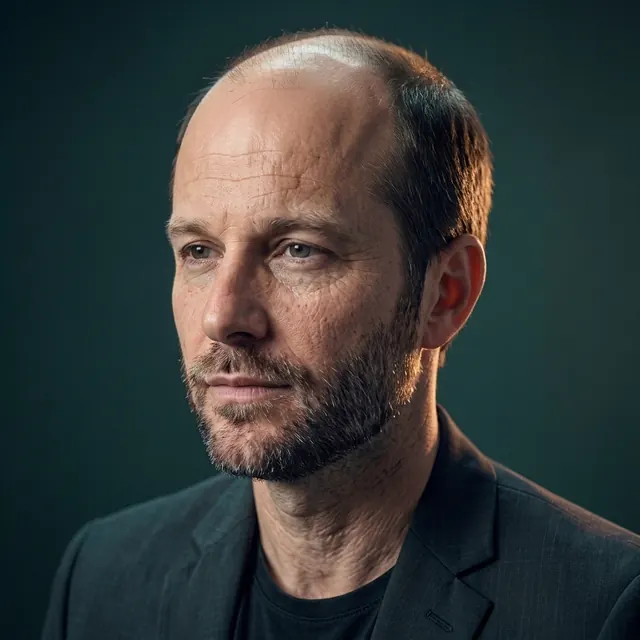
Front and crown merge into one bald area across the top; hair remains on the sides and back. Large sessions, our up-to-5,500-graft single sessions exist for exactly this stage.
Up to 5,500 grafts in one session
Only the band around the sides and back remains. Transplantation is still possible with a strong donor, with honest expectations: strategic coverage and a natural frame, not teenage density.
Candidacy-dependent; strategic coverage planningWe do not publish graft counts by stage, because two men at the same stage can need very different numbers. Your number comes from measuring your zones and your donor capacity, free, at the consultation.
| Stage | First move | Transplant? |
|---|---|---|
| 1–2 | Monitor with photos; manage DHT early if family history is aggressive | Rarely, stabilize first |
| 3 | Stabilize (DHT management, PRP) + consider restoring the frame | Yes, smallest sessions, best long-term canvases |
| 4–5 | Stabilization + restoration planned together | Yes, the most common surgical stages |
| 6 | Large-session planning; donor math decides design | Yes, up to 5,500 grafts in one session |
| 7 | Honest candidacy evaluation first | Case by case, strategic coverage, honest expectations |
Whatever the stage: a transplant alone does not stop ongoing loss. The follicles we move are DHT-resistant; the hair around them needs a protection plan. Staging without a stabilization plan is half a diagnosis.
From stage 3 onward, typically, the first definitive balding. Stages 2 and early 3 usually stabilize first. Operating on unstable early loss is how chasing-the-recession results happen.
Genetics decides the curve; treatment bends it. Many men hold at 2–3 for decades, especially with early DHT management. Six-month photos tell you YOUR speed, nothing else does.
Women are staged on the Ludwig scale, diffuse thinning with a preserved hairline, a different pattern entirely. See our female hair loss page.
Good. The photo did its job years before the mirror would have. Next step is professional staging and a stabilization plan. The free consultation covers both, and nobody will push surgery you do not need: ask the stage-2 patients we sent home with a camera reminder.
Free staging: your Norwood stage, your progression risk, and your honest options, surgical or not.
Schedule a Call